
WELCOME BONUS 300%
UP TO €2000 + 100
FREE SPINS
UP TO €2000 + 100
FREE SPINS
Home → Blackjack
Blackjack at Monro Casino: Variants, Rules and Payouts
Soft 17: Dealer Hits or Stands
Dealer Hits Soft 17 increases the house edge by 0.22 percentage points compared to a standing dealer, directly reducing the player's expected return. This rule modifier is present in the standard Blackjack Split / Double / H17 variant offered at the venue, where the RTP remains unlisted due to variable rule sets. High rollers must account for this specific disadvantage when calculating long-term loss rates on high-stakes hands.
In contrast, the Liberal Vegas Strip game enforces a Stand on Soft 17 (S17) condition alongside other favorable rules like Double After Split and Late Surrender. This combination yields a significantly lower house edge of 0.28 percent and an RTP of 99.72 percent, making it one of the most player-friendly options available. The statistical advantage shifts clearly in favor of the bettor when the dealer is restricted from hitting soft totals.
The Quantum Blackjack Plus Live table by Playtech operates with a standard set of rules that typically include standing on soft 17 to maintain its 99.57 percent RTP. Players engaging with multipliers up to 1,000x must still navigate the base game mathematics where dealer behavior dictates the fundamental variance. Deviating from optimal strategy in these live environments amplifies the impact of even minor rule differences on the final bankroll.
Bonus conditions often exclude Blackjack completely
Table games contribute only 10 percent toward the wagering requirements of the 300 percent welcome bonus up to 2,000 euros plus 100 free spins. This low contribution rate means that a 100 euro wager on blackjack generates merely 10 euros of progress toward the required turnover volume. Slots, contributing 100 percent, offer a much faster path to clearing the bonus funds compared to card games.
Calculating the actual turnover needed reveals the burden placed on high roller players who prefer table games over slots. To clear a 2,000 euro bonus amount with a standard 40x wagering requirement, a player needs 80,000 euros in total bets. If playing blackjack exclusively, they must place 800,000 euros in wagers because each bet only counts as 10 percent, creating a massive volume barrier.
Some variants may be excluded entirely from bonus play, though the general category restriction already imposes a severe penalty on card game enthusiasts. The 6 Decks, S17, DAS, DOA variant with a 0.46 percent house edge becomes financially inefficient under these terms due to the slow credit accumulation. Players seeking to utilize the bonus should verify if specific live tables like Infinite Blackjack fall under the excluded categories.
Double Down after Split: which tables allow it
Double After Split (DAS) reduces the house edge by approximately 0.14 percentage points, offering a measurable advantage to skilled players who can double down on split hands. This rule is explicitly permitted in the Liberal Vegas Strip variant, which boasts a low 0.28 percent house edge and an RTP of 99.72 percent. Allowing additional doubling opportunities significantly enhances the potential profitability of splitting pairs during high-volume sessions.
The standard Blackjack Split / Double / H17 variant also permits Double After Split, contributing to its specific rule-modifier profile despite the higher dealer hit soft 17 penalty. In this context, the DAS benefit partially offsets other disadvantages, though the overall RTP remains undefined due to the complex interplay of multiple rule variables. High rollers utilizing this variant must balance the DAS advantage against the increased house edge from other restrictive conditions.
Live dealer tables such as Quantum Blackjack Plus Live by Playtech and Infinite Blackjack by Evolution generally support advanced betting strategies including DAS to attract serious players. These tables feature high limits up to 5,000 euros, allowing substantial wagers where the cumulative effect of DAS can mitigate the house edge over time. The availability of this rule is critical for players employing basic strategy variations that rely on splitting and doubling sequences.
Bonus 100 EUR with 10 percent credit
Wagering 100 euros on any blackjack table generates only 10 euros of credit toward the bonus turnover requirement due to the 10 percent contribution rate. This means that for every 1,000 euros staked on cards, the player effectively clears only 100 euros of the required wagering volume. The disparity between table game contributions and the 100 percent slot contribution creates a significant inefficiency for bonus hunters preferring cards.
Comparing this to the Liberal Vegas Strip variant with a 0.28 percent house edge, the cost of generating turnover is amplified by the bonus terms. A player needing 4,000 euros of cleared bonus value must wager 40,000 euros on slots but 400,000 euros on blackjack to achieve the same result. The financial burden of meeting wagering requirements through table games makes the 300 percent match less attractive for high rollers.
The Infinite Blackjack table by Evolution allows bets up to 5,000 euros per round, providing high-velocity turnover potential despite the 10 percent credit cap. However, the sheer volume required to clear a 2,000 euro bonus becomes prohibitive when restricted to table games with such low contribution percentages. Players must weigh the entertainment value against the mathematical reality of the extended playtime needed to unlock withdrawable funds.
Ace Split: only one card per hand
Most blackjack variants at the casino restrict resplitting aces to receiving only one additional card per hand, limiting the potential for further advantageous plays. This rule applies to the standard Blackjack Split / Double / H17 game, where the resplit ace benefit improves RTP by only 0.08 percentage points. The restriction prevents players from maximizing the value of their strongest starting hand through multiple doubling opportunities.
The Blackjack Ein Deck, classical rules variant with a 99.85 percent RTP typically enforces strict ace splitting rules to maintain its theoretical edge. While single-deck games generally offer better odds than multi-deck versions, the one-card-per-ace limitation reduces the strategic depth available to high rollers. Players relying on precise basic strategy must adjust their expectations regarding the frequency of successful ace splits.
Live tables like Quantum Blackjack Plus Live and Infinite Blackjack by Evolution often mirror these standard restrictions on ace splitting to manage variance and house edge. Even with high limits and side bets, the fundamental rule of receiving one card per split ace remains consistent across most provider implementations. This constraint ensures that the statistical advantage derived from splitting aces remains marginal compared to other rule modifications.
Blackjack variants at a glance
| Variant | Payout | House edge | Rule | Bet range |
|---|---|---|---|---|
| Blackjack Insurance / Versicherung (6–8 Decks) | 92.53% | 7.47% | Separate Nebenwette bis 50% der Hauptwette, wenn der Dealer ein Ass hat. Basisstrategie schreibt IMMER Ablehnung vor (außer Karten zählen bei True Count ≥ +3). Bei einem Deck Vorteil ≈ 5.88% | Insurance 2:1 |
| Blackjack Liberal Vegas Strip (liberale Regeln, 3:2) | 99.72% | 0.28% | Günstigste Regelkombination: S17 + DAS + Resplit + Late Surrender. Standardabweichung 1,15 | Blackjack 3:2, Gewinn 1:1 |
| Blackjack Ein Deck, klassische Regeln, 3:2 | 99.85% | 0.15% | Weniger Decks = niedrigerer Vorteil; ein Deck gibt ca. −0.48 Prozentpunkte gegenüber 8 Decks. Oft durch 6:5 Auszahlung kompensiert. | Blackjack 3:2, Gewinn 1:1 |
| Blackjack Split / Double / H17 – Regel-Effekte | n.a. (Regel-Modifikatoren) | H17 +0.22 Prozentpunkte; RSA −0.08 Prozentpunkte; DAS −0.14 Prozentpunkte | Dealer Hits Soft 17 verschlechtert RTP um 0.22 Prozentpunkte; Resplit Aces verbessert um 0.08 Prozentpunkte; Double After Split verbessert um ca. 0.14 Prozentpunkte; 6 Decks statt 8 – ca. 0.02 Prozentpunkte. | Double – Einsatz ×2 mit einer Karte; Split – bis 4 Hände; Ass-Split meist mit einer Karte. |
| Blackjack Surrender (Late Surrender) – Regel-Effekt | n.a. (Regel-Modifikator) | −0.08 Prozentpunkte | Spieler gibt Hand nach Dealer-Blackjack-Prüfung auf, verliert die Hälfte des Einsatzes. Verbessert RTP um ca. 0.08 Prozentpunkte. Early Surrender ist wesentlich wertvoller (bis −0.6 Prozentpunkte), aber extrem selten. | Rückzahlung 50% des Einsatzes |
| Blackjack Auszahlung 6:5 statt 3:2 (6 Decks) | 98.15% | 1.85% | Ersatz von 3:2 durch 6:5 fügt exakt +1.39 Prozentpunkte zum Vorteil des Casinos hinzu – stärker als jede andere Regeländerung. Bei $10 Einsatz zahlt Blackjack $12 statt $15. | Blackjack 6:5, Gewinn 1:1 |
16 vs 10 played incorrectly: most common error
The Blackjack 6 Decks variant at Monro Casino enforces a strict S17 rule where the dealer stands on soft seventeen, which fundamentally alters the expected value for players holding sixteen against a dealer ten. This specific configuration demands that the player hit their sixteen because standing yields a negative expectation, whereas basic strategy dictates hitting to minimize the house edge of 0.46 percent over the long run. Failing to follow this mandatory move increases the casino's advantage significantly, turning a manageable loss into a costly error that erodes the bankroll faster than any other strategic deviation.
Comparing this standard six-deck game to the Liberal Vegas Strip version reveals that the latter offers a superior RTP of 99.72 percent due to its liberal rules like resplitting and late surrender. The six-deck game lacks these player-friendly modifiers, resulting in a higher house edge of 0.46 percent compared to the 0.28 percent found in the Vegas Strip variant. Players who fail to adapt their strategy from the more favorable Vegas rules to the stricter S17 environment will lose money at an accelerated rate because the statistical probability of winning decreases without the additional options.
The Quantum Blackjack Plus Live table by Playtech introduces multipliers up to 1000x on three-card combinations totaling twenty-one points, which can offset some losses from poor basic strategy decisions during high-stakes rounds. While the base RTP remains 99.57 percent with optimal play, the variance is much higher, meaning incorrect plays on sixteen versus ten become even more dangerous as they miss out on potential multiplier bonuses. High rollers must combine perfect basic strategy with an understanding of how quantum multipliers impact short-term volatility to avoid compounding errors when large bets are placed at this dynamic live table.
What Push Means: Stake Returns to You
A push occurs when both the player and the dealer hold equal hand values, such as both finishing with eighteen points, resulting in the original stake being returned without any profit or loss. In the Blackjack 3:2 payout structure, a natural blackjack pays 1.5 times the bet, but a push ensures the player retains their full wager, preserving the bankroll for subsequent hands in the session. This mechanism is crucial for managing risk, as it prevents the immediate depletion of funds during streaks where neither party achieves a decisive win against the dealer's final hand total.
The Insurance side bet, which pays 2:1 if the dealer has a blackjack, is statistically inferior with a house edge of 7.47 percent, making it a losing proposition unless card counting indicates a true count of plus three or higher. Accepting insurance when the count is low effectively guarantees a loss on that side wager while potentially pushing the main hand, which does not compensate for the significant reduction in overall return to player. High rollers should avoid this trap entirely, as the 7.47 percent disadvantage far exceeds the 0.46 percent house edge of the base game, destroying long-term profitability regardless of short-term outcomes.
Infinite Blackjack by Evolution allows unlimited players at the table, meaning pushes are more frequent simply due to the larger volume of hands dealt per hour compared to traditional tables with limited seats. The RTP of 99.47 percent reflects this efficiency, but the sheer number of pushes means players must endure longer sessions to realize the theoretical return, requiring substantial bankrolls to withstand the variance. Understanding that a push merely returns the stake helps players maintain discipline, knowing that every non-push decision directly impacts the bottom line based on the specific rules of the table.
The Surrender rule, specifically Late Surrender, allows players to forfeit half their bet after the dealer checks for blackjack, improving the RTP by approximately 0.08 percentage points compared to games without this option. Choosing to surrender a hard sixteen against a dealer nine is often mathematically superior to playing out the hand, as it limits the loss to fifty percent rather than risking the entire stake on a likely losing outcome. This strategic choice is vital for preserving capital, especially in high-limit environments where the absolute amount lost on a failed hand would be disproportionately large relative to the initial investment.
Card Counting at Shuffle Master Table: why it fails
Continuous shuffling machines used in many online live dealer studios eliminate the primary advantage of card counting by resetting the deck composition after every single hand, rendering trackable card distributions irrelevant for predicting future outcomes. Unlike physical tables where cards are dealt from a shoe until penetration reaches a certain depth, digital shuffle algorithms ensure that the house edge remains constant at 0.46 percent for the six-deck game regardless of previous results. This technological barrier prevents skilled players from gaining the statistical edge needed to overcome the casino's mathematical advantage, making consistent profits through counting impossible in these environments.
The Quantum Blackjack Plus Live table features random multipliers applied to winning hands, which introduces extreme volatility that further disrupts any potential counting strategies by altering the payout structure dynamically during the round. Even if a player could theoretically track cards, the unpredictable nature of the 1000x multipliers on twenty-one combinations makes it impossible to calculate accurate betting spreads based on card removal effects. The integration of these bonus features changes the fundamental mathematics of the game, ensuring that the standard counting systems developed for traditional blackjack are ineffective against the randomized payout mechanics.
Live tables typically use eight decks instead of six, which slightly reduces the effectiveness of any counting system due to the larger pool of cards diluting the impact of individual card removals. The Infinite Blackjack variant by Evolution maintains an RTP of 99.47 percent, but the continuous shuffling technology ensures that the true count never accumulates enough positive value to justify increased wagers. High rollers relying on advanced techniques will find that the casino's deployment of automated shuffling neutralizes the skill-based aspect of the game, forcing players to rely solely on luck and basic strategy for returns.
How long does a Live Blackjack round take?
A typical live blackjack round at Monro Casino takes approximately two to three minutes from the start of betting to the resolution of all hands, depending on the number of active players at the table. The Infinite Blackjack table by Evolution supports unlimited participants, which can extend the duration of each round as the dealer processes actions for every seat before dealing the next set of cards. This variability means that high rollers playing with multiple concurrent hands may experience slower pacing, requiring patience and a larger bankroll to sustain activity during peak hours when the table is fully occupied.
The Quantum Blackjack Plus Live variant by Playtech adds extra time to each round due to the animation and calculation of quantum multipliers, which can delay the final payout display by several seconds after the hand resolves. With bets ranging from one to five thousand euros, the extended duration ensures that large transactions are processed correctly and that the visual effects of multipliers up to 1000x are fully rendered for all viewers. This added latency contributes to a longer average session time, allowing players to engage with the game's unique features without rushing through the critical decision-making phases of each deal.
Blackjack Party by Evolution incorporates two moderators who create a lively atmosphere, which can subtly influence the pace of play by encouraging social interaction and additional commentary between hands. The betting range of one to one thousand euros accommodates a wide variety of stakes, but the entertainment-focused format may result in slightly slower gameplay compared to more streamlined variants like the standard six-deck game. Players seeking rapid turnover might prefer tables with fewer interactive elements, while those valuing engagement should anticipate a moderately relaxed tempo that prioritizes enjoyment over speed.
The standard six-deck game with S17 rules operates efficiently with minimal downtime between rounds, facilitating a steady flow of hands that appeals to serious strategists who require consistent data points for analysis. Each round involves clear steps: betting, dealing, player decisions, dealer play, and settlement, all executed within a timeframe that balances thoroughness with operational efficiency. Understanding this rhythm helps players manage their time effectively, ensuring they can complete sufficient volumes of hands to approach the theoretical RTP of 99.54 percent over a sustained period.
Splitting tens costs expected value: better stand
Splitting a pair of tens, which totals twenty points, is a statistically unsound move because it breaks a strong hand into two weaker starting hands of ten, significantly reducing the overall expected value of the round. In the six-deck game with a house edge of 0.46 percent, standing on twenty wins approximately eighty-five percent of the time against dealer up-cards seven through nine, whereas splitting exposes both tens to the risk of busting or losing to a dealer blackjack. This error is particularly costly for high rollers, as the potential gain from two separate hands rarely compensates for the guaranteed loss of the high-probability twenty-point total.
The Liberal Vegas Strip variant allows resplitting aces, which is a beneficial rule, but it does not change the fundamental logic that splitting tens remains a negative expectation play due to the strength of the combined hand. With an RTP of 99.72 percent, the game rewards disciplined strategy, and deviating from basic strategy by splitting tens increases the house edge substantially, eroding the player's advantage over time. Players must recognize that twenty is a near-certain winner in most scenarios, and splitting it sacrifices this certainty for a marginal chance at doubling their exposure to the dealer's potential improvements.
In Infinite Blackjack by Evolution, the presence of side bets like Any Pair or Hot 3 might tempt players to split tens in hopes of triggering bonus payouts, but this distraction ignores the core mathematical reality of the base game. The side bets carry their own house edges, and focusing on them while splitting strong hands compounds the losses by diverting attention from optimal basic strategy decisions. High rollers should prioritize the primary game's RTP of 99.47 percent by standing on twenty, avoiding the temptation to chase secondary wins that do not alter the underlying probability of the main hand.
The Blackjack Party variant by Evolution emphasizes entertainment, but the moderator's guidance should still reinforce basic strategy, including the imperative to stand on hard twenty rather than splitting tens. With a betting limit of one thousand euros, the financial impact of splitting tens is less severe than at higher-limit tables, but the principle remains identical: breaking a winning hand reduces long-term profitability. Players who consistently stand on twenty preserve their bankroll more effectively, aligning their behavior with the mathematical expectations that define successful blackjack strategy across all table types.
Error insurance: 7 percent additional house edge
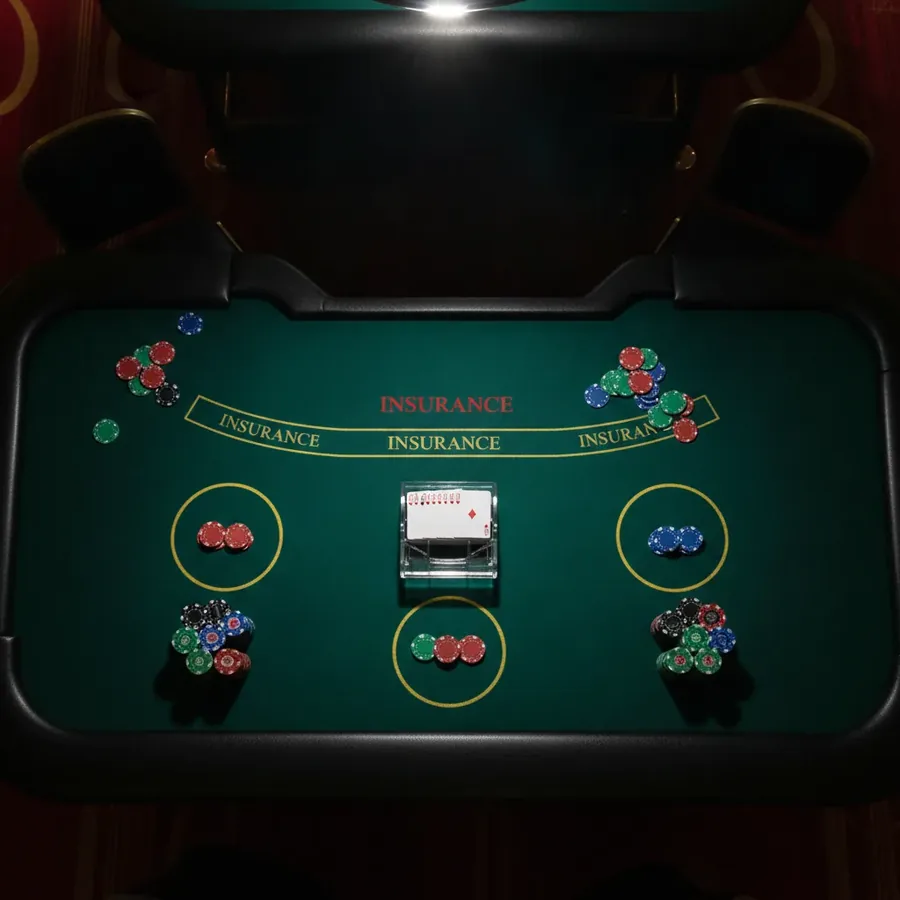
The Insurance side bet in Blackjack carries a steep 7.47% house edge, significantly worsening the overall return for high rollers who accept this optional wager when the dealer shows an Ace. This separate bet allows players to risk up to 50% of their main stake, but basic strategy strictly advises against it unless counting cards reaches a true count of +3 or higher.
Standard RNG games using six to eight decks impose this exact 7.47% disadvantage, which is far worse than the base game RTP of 99.54% found in liberal Vegas Strip variants. The payout ratio of 2:1 fails to compensate for the probability of the dealer holding a ten-value card, resulting in a theoretical return of only 92.53% over the long term.
High stakes players should avoid this bet entirely as it erodes bankroll faster than any other rule modification, turning a favorable situation into a mathematical loss. Only those utilizing advanced card counting techniques might find value here, but for standard play, the 7.47% edge makes it one of the worst wagers available at Monro Casino.
Place Side Bet before cards are dealt
Infinite Blackjack by Evolution offers four distinct side bets including Any Pair, 21+3, Hot 3, and Bust It, all of which must be placed before the initial deal begins. These wagers sit alongside the main game action, allowing high rollers to diversify their betting strategy while maintaining the standard table limits ranging from 1 EUR to 5,000 EUR per round.
The Quantum Blackjack Plus Live variant by Playtech introduces Quantum Multipliers that can reach up to 1,000x on specific three-card combinations totaling 21 points. Players must decide on these multiplier bets before the cards are drawn, adding a layer of volatility to the standard 99.57% RTP based on optimal strategy execution.
Unlike standard table games where side bets are optional extras, these live dealer formats integrate them deeply into the gameplay loop, requiring precise timing from the participant. The maximum potential payout on a single hand can skyrocket due to the 1,000x multiplier, but the underlying odds remain heavily skewed toward the house compared to pure blackjack outcomes.
RNG draws cards from virtual eight-deck shoe
The standard RNG Blackjack variant at Monro Casino utilizes a virtual eight-deck shoe, which increases the house edge by approximately 0.48% compared to single-deck versions. This configuration supports a base RTP of 99.54% when playing with soft 17 standing rules, double after split allowances, and late surrender options enabled for optimal strategic play.
Using more decks dilutes the effectiveness of card counting and reduces the impact of removal effects, making the game less favorable for skilled high rollers seeking an edge. The eight-deck setup ensures continuous shuffling mechanics are not required, yet it maintains a consistent distribution of cards that favors the casino's statistical advantage over time.
This specific rule set contrasts sharply with the 6-deck version offering 3:2 payouts, which provides a lower house edge of 0.46% under identical strategic conditions. High stakes players should verify the deck count before joining, as the difference between six and eight decks directly impacts the theoretical return and long-term profitability of their betting sessions.
Which table limits suit 20 EUR balance?
A 20 EUR bankroll is insufficient for most high-stakes tables at Monro Casino, as even the lowest entry point for Infinite Blackjack starts at 1 EUR. While technically playable, this balance leaves zero room for variance, meaning a single losing streak of five hands would deplete the entire stake without allowing for strategic doubling or splitting maneuvers.
Blackjack Party by Evolution requires a minimum bet of 1.00 EUR, which is marginally more accessible but still extremely risky for a 20 EUR balance. The party atmosphere and dual moderators do not alter the mathematical reality that high volatility will likely exhaust such a small fund before any significant winning session can occur.
Quantum Blackjack Plus Live by Playtech also starts at 1 EUR, but the presence of multipliers means losses can accumulate rapidly if unlucky draws occur. A 20 EUR balance is essentially unviable for serious play, as the recommended unit size for bankroll management should never exceed 1-2% of total funds, suggesting a minimum starting balance of 1,000 EUR for proper risk control.
When can you increase your bet?
Players may increase their bet specifically during the 'Double' phase, which is permitted only after receiving the first two cards and involves doubling the original stake. This action is restricted to the initial deal and cannot be repeated later in the hand, limiting high rollers to a single opportunity to maximize exposure on strong starting totals like 11 or 10.
The 'Split' feature allows players to divide pairs into two separate hands, effectively doubling the total wager on the table for that round. Resplitting Aces is often allowed with one card each, while other pairs may be resplit up to four hands, providing multiple avenues to increase bet size strategically within the same dealing sequence.
Insurance bets can be increased up to 50% of the main wager when the dealer shows an Ace, but this is a defensive move rather than an offensive one. High rollers should note that increasing bets via splits or doubles does not change the house edge, but it does amplify the variance and potential swing in bankroll during volatile sessions at Monro Casino.
Contact
Live - online chat
Banking




Providers











Monro Casino 2026